THE MORNING YOU STOP COUNTING THE PATCHES
Hair systems for alopecia can help you feel more confident when hair loss makes everyday life unpredictable. You already know the routine. Check the mirror, tilt your head, see if the patch has grown overnight. Reach for a cap, a scarf, or just decide today is a stay-indoors day. Alopecia does not follow a schedule, and neither does your confidence when it flares up.
What makes it harder is how unpredictable it feels. One month it is a coin-sized patch behind your ear. The next it is spreading across the crown, or gone completely, or back somewhere new. Planning around hair loss that will not sit still is exhausting on its own, before you even get to how people react when they notice.
Here is the part that gets missed a lot: you do not have to wait for a diagnosis to resolve or a treatment to work before you get your hair back. Hair systems for alopecia exist specifically for this in-between space, whether the cause is alopecia areata, totalis, universalis, or long-term androgenetic thinning.
This guide walks through what actually works for alopecia clients, the specific system types built for sensitive or patchy scalps, and the mistakes that lead people to give up on hair systems before they have tried the right one.
HAIR SYSTEMS FOR ALOPECIA: QUICK ANSWER
There is no single hair system that works for every type of alopecia. Full vacuum-based or skin systems work best for complete or near-complete hair loss, such as alopecia totalis or universalis. Clip-in toppers and partial mono-top systems work well for patchy alopecia areata where some natural hair remains. Lace and thin-skin combination bases suit clients who need a soft, undetectable edge around active patches. What matters most with hair systems for alopecia is choosing a base and attachment method that will not irritate a scalp that may already be sensitive or actively changing.
WHAT ACTUALLY HAPPENS WITH ALOPECIA AND HAIR SYSTEMS
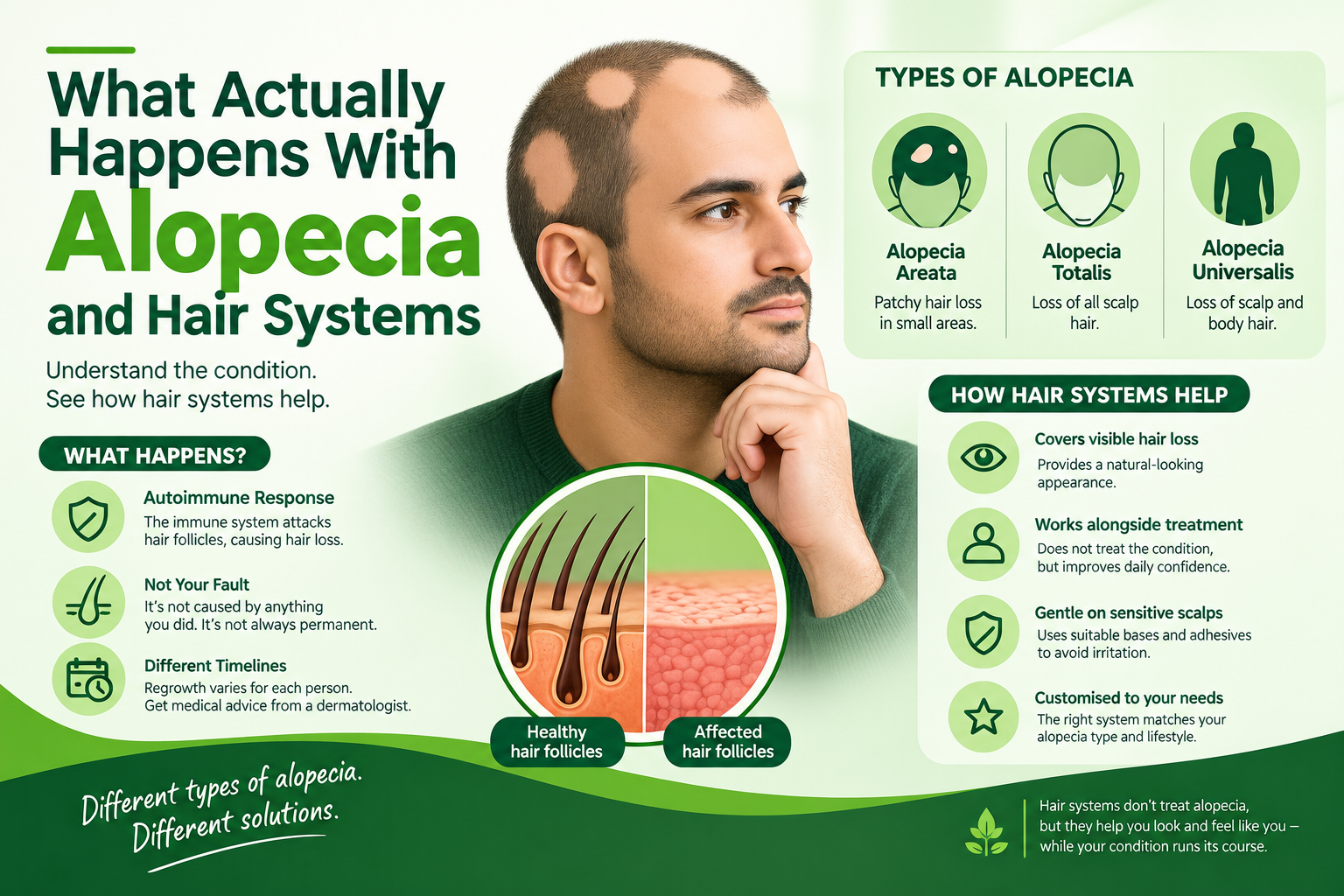
>>>>>lass=”yoast-text-mark” />>Alopecia areata is an autoimmune condition where the body’s immune system attacks hair follicles, causing hair to fall out in patches. Alopecia totalis means the loss covers the entire scalp, and alopecia universalis extends to body hair as well. None of these are caused by anything the person did, and none of them are permanent by definition, though the timeline for regrowth is different for every person and is a question for a dermatologist, not a hairstylist. The National Alopecia Areata Foundation is a useful starting point if you want to understand the medical side in more depth.
A hair system does not treat the underlying condition. What it does is cover the visible loss with a natural-looking base while the condition runs its course, whatever that course turns out to be. This matters because it separates two different jobs: a dermatologist manages the alopecia itself, and a hair system provider manages how it looks day to day.
The scalp underneath alopecia patches is often more sensitive than scalp under regular thinning hair, especially in active or recently affected areas. This is why the base material and adhesive matter more here than in a standard hair replacement case. A base that is too stiff, or an adhesive that is too aggressive, can irritate skin that is already under stress. Clients in humid cities like Hyderabad or Kurnool also deal with extra scalp sweat, which changes how often a system needs to be cleaned or reattached.
WHY THIS MATTERS MORE THAN PEOPLE REALIZE
Alopecia is not just a cosmetic issue, but the visible part of it carries a real social weight that people without the condition rarely have to think about. A client with patchy areata who picks a system built for full baldness ends up with a bulky, obvious fit. A client with total hair loss who tries a lightweight clip system made for partial coverage will find nothing to clip onto.
Getting the system type wrong wastes money and, worse, convinces people that hair systems for alopecia do not work at all, when the real issue was a mismatch between the system and the type of alopecia.
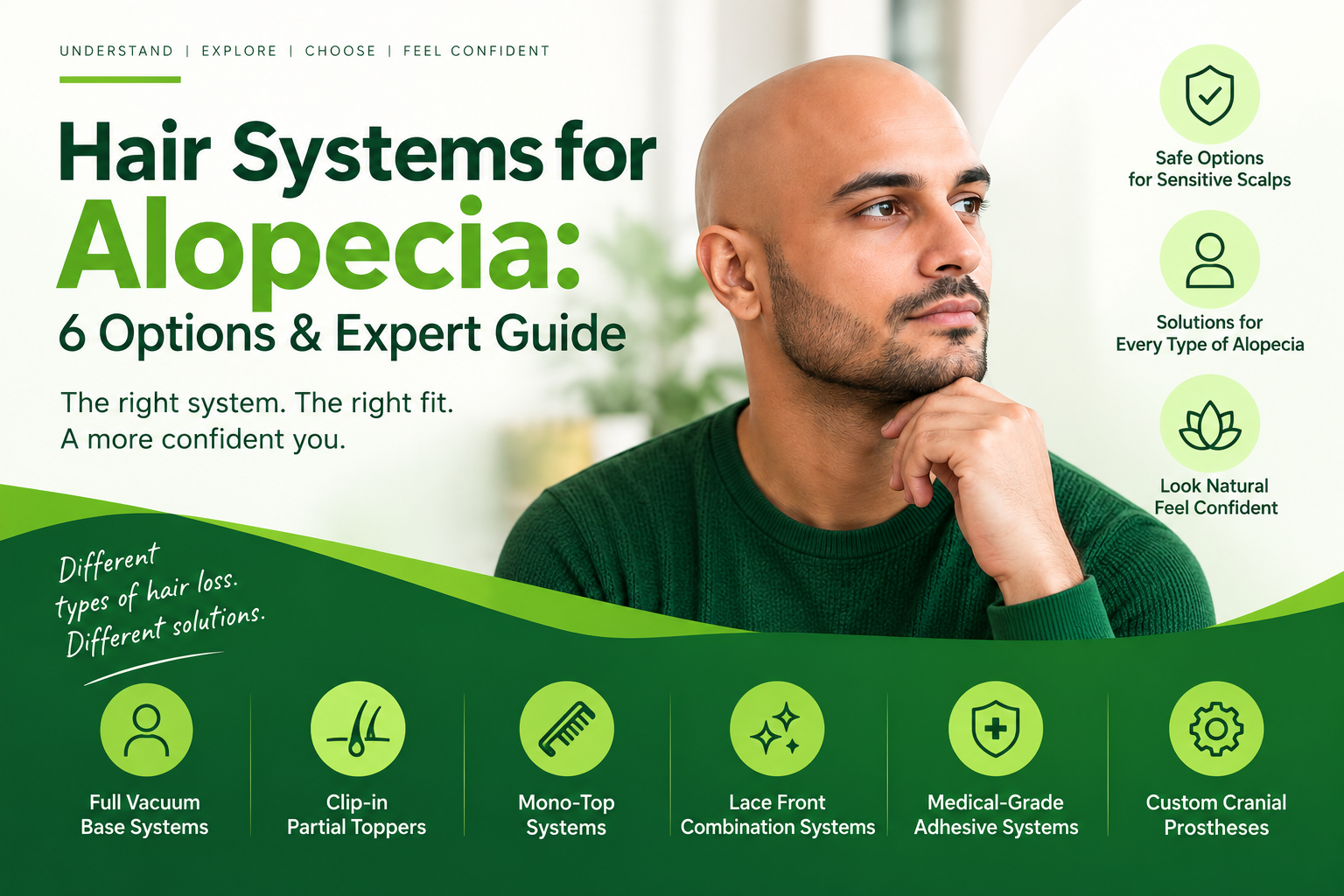
SIX HAIR SYSTEM OPTIONS FOR PEOPLE WITH ALOPECIA
1. FULL VACUUM BASE SYSTEMS
What it means: A complete base, usually silicone or a soft polyurethane blend, that seals against the scalp using suction rather than adhesive along the full perimeter.
Why it matters: For alopecia totalis or universalis, there is no remaining natural hair to attach to or blend with, so a full-coverage base is the only realistic option.
How to do it: The scalp is measured for an exact custom mold, and the base is fitted so the suction seal forms evenly without needing tape or glue at all.
Example: A client with alopecia universalis in Bangalore switched to a vacuum base specifically because he wanted a system he could remove and reseal himself without daily adhesive application.
Pro tip: Vacuum bases need a completely smooth, hair-free scalp to seal properly, so any remaining fine hair usually needs to be shaved first.
2. CLIP-IN PARTIAL TOPPERS
What it means: A smaller hairpiece that clips onto existing hair around a specific bald or thinning patch rather than covering the whole scalp.
Why it matters: Many alopecia areata cases involve isolated patches with plenty of natural hair everywhere else, so a full system would be unnecessary and uncomfortable.
How to do it: The topper is sized and color-matched to the patch, then clipped into the surrounding natural hair so the edges blend into your own growth.
Example: A client from Warangal with two coin-sized patches near her part line uses a single small topper that she moves and repositions herself at home.
Pro tip: Keep a couple of clip positions marked with your stylist so repositioning at home stays consistent and does not stretch the natural hair around the patch.
3. MONO-TOP SYSTEMS
What it means: A base made of fine mesh where each hair strand is individually knotted, giving a natural scalp-like appearance through the mesh.
Why it matters: Mono-top bases are breathable and gentle, which matters when the scalp underneath has recently lost hair and may still be tender.
How to do it: The mono section is positioned over the affected area and secured with a light adhesive or small clips depending on how much surrounding hair is available.
Example: Think of the mesh the way a fine window screen lets air through while still doing its job, rather than a solid sheet that traps heat and moisture.
Pro tip: Ask for a slightly looser knotting density around any patch that is still actively shedding, since tighter knots can pull on fragile regrowth.
4. LACE FRONT COMBINATION SYSTEMS
What it means: A system using a soft lace panel at the front hairline combined with a sturdier base further back, giving a natural edge where it is most visible.
Why it matters: The front hairline is the area people notice first, so alopecia clients with patches near the forehead often want the softest, most undetectable material right there.
How to do it: The lace section is trimmed and set along the natural hairline first, then the rest of the base is secured using whichever attachment method suits the scalp condition further back.
Example: A client preparing for a family wedding in Hyderabad chose a lace front specifically for close-up photos, since a thicker base tends to show a visible line at the hairline.
Pro tip: Lace fronts need gentler cleaning products than standard bases, since the fine mesh can fray with harsh shampoos.
5. MEDICAL-GRADE ADHESIVE SYSTEMS
What it means: Attachment using hypoallergenic, dermatologically tested adhesives designed for skin that reacts to standard wig tape or glue.
Why it matters: Many alopecia clients have already dealt with skin sensitivity from the condition itself, so a standard adhesive can trigger irritation that has nothing to do with the hair system itself.
How to do it: A patch test is done on a small area of skin before the full application, and the adhesive is applied in a thinner layer than usual to reduce contact time and residue.
Example: A client whose alopecia areata came with noticeably drier, more reactive skin around the affected patches needed three different adhesive brands tested before finding one that did not cause redness.
Pro tip: Always ask for a 24-hour patch test before your first full application if you have any history of skin sensitivity, not just alopecia specifically.
6. CUSTOM CRANIAL PROSTHESIS
What it means: A medically classified hair replacement system, often documented for insurance or tax purposes as a prosthesis rather than a cosmetic wig.
Why it matters: For total or near-total hair loss from a medical condition, some clients want documentation that distinguishes this from an elective cosmetic product.
How to do it: The system is custom-built from a scalp mold, using the same craftsmanship as a full vacuum base, with paperwork prepared alongside it if the client needs it for medical or insurance purposes.
Example: One client requested this specifically to submit alongside medical documentation for his alopecia universalis diagnosis.
Pro tip: Ask upfront whether your provider issues documentation in this format, since not every studio prepares it as standard.
COMMON MISTAKES PEOPLE MAKE WITH HAIR SYSTEMS FOR ALOPECIA
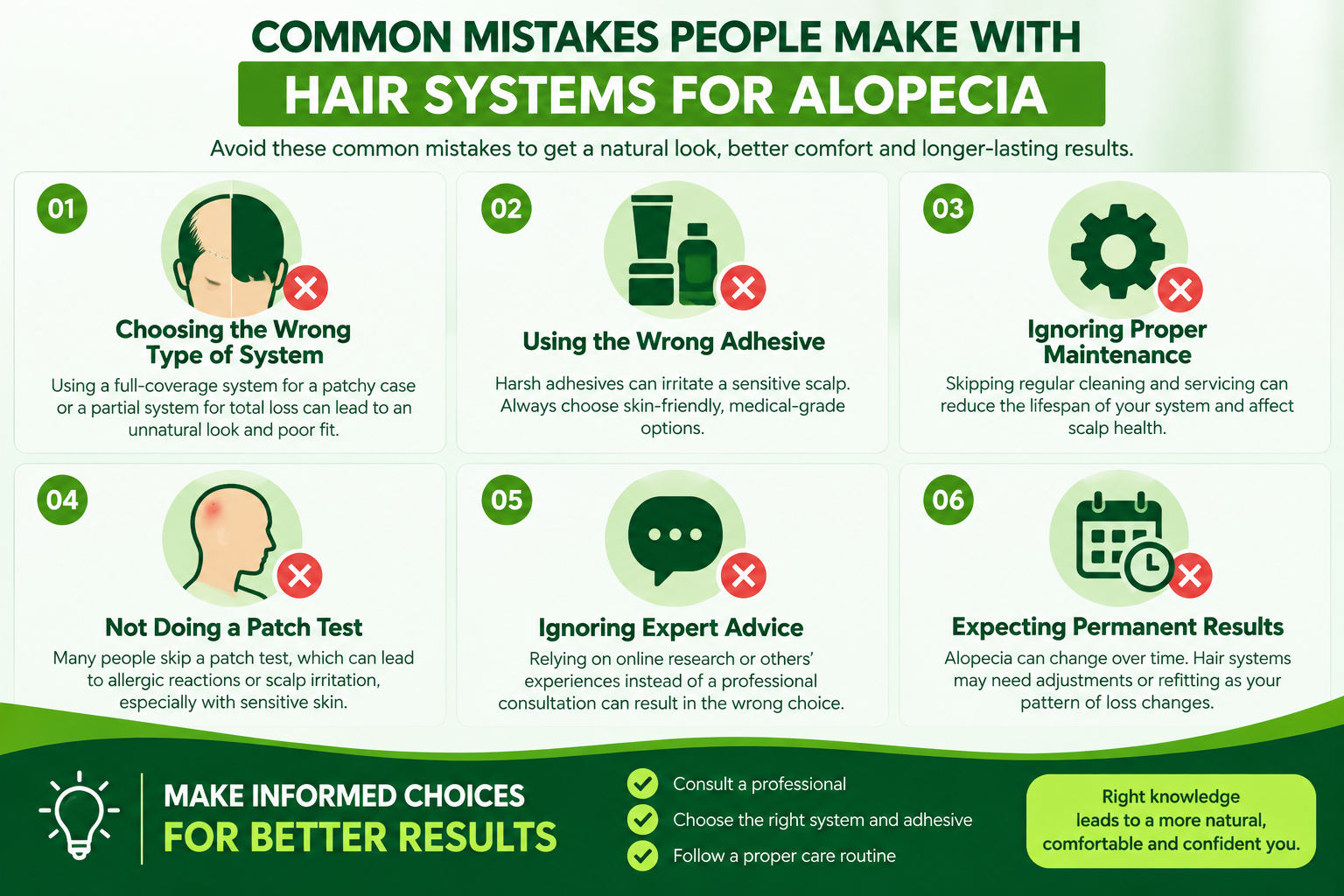
Mistake: Choosing a full-coverage base for a patchy, partial case of alopecia. Impact: The fit looks bulky and unnecessary over healthy remaining hair. Solution: Match the system size to the actual area affected, not the worst-case scenario.
Mistake: Using standard adhesive without a patch test. Impact: Irritation on skin that may already be sensitive from the condition. Solution: Always request a patch test before full application, especially on a first visit.
Mistake: Ignoring changes in the alopecia pattern over time. Impact: A system fitted for one patch layout no longer matches as patches shift or new regrowth appears. Solution: Schedule a refitting check every few months rather than assuming the original fit still works.
Mistake: Treating the hair system as a treatment for the alopecia itself. Impact: Delays proper dermatological evaluation of the underlying condition. Solution: Keep the hair system and the medical management as two separate, parallel conversations.
Mistake: Skipping breathable base options in humid climates. Impact: Increased scalp sweat and discomfort under a dense base. Solution: Ask specifically about mono-top or mesh options if you live somewhere hot and humid.
BEST PRACTICES FOR CHOOSING HAIR REPLACEMENT FOR ALOPECIA
Bring a dermatologist’s notes on your specific type of alopecia to your first hair system consultation if you have them.
Ask for a patch test on any new adhesive, even if you have used adhesive systems before without issue.
Keep a fixed reattachment schedule instead of waiting until the system feels loose.
Reassess the system fit every few months since alopecia patterns change more than typical thinning does.
Choose breathable base materials if your alopecia patches are still active or recently changed.
TOOLS AND PRODUCTS COMPARISON
</tbody>
| System Type | Best For | Scalp Sensitivity Fit | Coverage Level |
|---|---|---|---|
| Full vacuum base | Alopecia totalis or universalis | High | Full scalp |
| Clip-in topper | Isolated patches, areata | Moderate | Partial |
| Mono-top | Active or recently affected patches | High | Partial to full |
| Lace front combination | Hairline-focused patches | High | Partial to full |
| Medical-grade adhesive system | Reactive or sensitive skin | Very high | Depends on base |
| Custom cranial prosthesis | Documented medical need | High | Full scalp |
Exact pricing and turnaround time vary by studio, base material, and how custom the fit needs to be, so treat this as a general comparison of hair systems for alopecia rather than a fixed price list.
REAL LIFE CASE STUDY
Situation: A client with alopecia areata came in with three separate patches, one behind the ear and two near the crown, after a previous provider fitted her with a full-coverage system that covered her entire natural hair underneath.
Challenge: The full base trapped heat over her healthy hair, caused unnecessary sweating, and made the coverage look thicker than her actual hair loss required.
Action: We refitted her with a combination of two small mono-top patches sized to her exact patches, clipped into the surrounding natural hair rather than replacing it.
Result: Her scalp comfort improved within the first week, and her reattachment visits dropped since two small patches need far less maintenance than a full base.
EXPERT TIPS FOR LONG TERM CONFIDENCE
Keep your dermatologist and your hair system provider in separate conversations, but let each know about the other. Changes in your treatment can change how your scalp responds to adhesive, and vice versa.
Do not assume your first fitting is final. Alopecia patterns shift, and a system that fit perfectly six months ago may need adjusting as your hair changes.
If you travel often, keep a small kit with your specific adhesive brand, since not every studio stocks the same hypoallergenic products.
FREQUENTLY ASKED QUESTIONS
Can hair systems make alopecia worse? No. A properly fitted system does not affect the underlying autoimmune process. However, a poorly fitted system can cause skin irritation.
Do I need a diagnosis before getting a hair system? A diagnosis can help your stylist choose the right base and adhesive. However, you do not need to wait for a diagnosis to get started.
What is the difference between alopecia areata and alopecia totalis? Alopecia areata causes patchy hair loss. Alopecia totalis means the entire scalp has lost hair.
Can a hair system be removed if my hair grows back? Yes. Hair systems are removable at any point. Many clients transition to a partial system or stop using one after regrowth.
Are hair systems for alopecia more expensive than regular systems? Pricing depends mainly on the base type and customization. The cause of hair loss is not usually the main pricing factor.
How often do alopecia hair systems need reattachment or refitting? Reattachment follows the same schedule as standard systems, but refitting for pattern changes happens more often, often every few months.
Can children with alopecia use hair systems? Yes, though sizing, materials, and comfort needs are different for younger scalps, so a specialized fitting is important.
Will people be able to tell I am wearing a hair system? A well-matched base, color, and density should be undetectable at normal social distance.
Is a patch test really necessary for alopecia clients? Yes, since skin affected by alopecia can react differently to adhesives than unaffected skin.
Can hair systems help with alopecia universalis, including eyebrows? Scalp systems address the scalp specifically, though some providers also offer separate solutions for eyebrows and lashes.
KEY TAKEAWAYS
Match your hair system for alopecia to your specific pattern of loss. Do not choose a system based on the most severe case you have heard about.
Request a patch test before any adhesive application if your skin has any history of sensitivity.
Keep your dermatologist and your hair system provider informed about each other.
Reassess your fit every few months since alopecia patterns change more than regular thinning.
Choose breathable bases if your scalp is still active or humid climates are part of your daily routine.
CONCLUSION
Hair systems for alopecia work best when they match the actual pattern of hair loss. They should not be treated as a one-size-fits-all solution. Patchy hair loss needs a different approach from total hair loss. A sensitive scalp may also need a gentler adhesive.
Your dermatologist can provide important medical guidance. Your hair system provider can help with fit, comfort, and appearance. Keeping both involved can help you choose a system that suits your needs. Avoid choosing a system only because it worked for someone else.
READY TO FIND THE RIGHT HAIR SYSTEM FOR YOUR ALOPECIA?
If your current system feels bulky or irritates your scalp, the fit may be the problem. Your alopecia may also have changed since your last fitting. A system that worked before may no longer suit your current needs.
Book a consultation with our team. We will assess your hair-loss pattern, scalp sensitivity, and daily routine. Then, we can help you choose a system that suits your case.
Visit needshairstudio.com or call your nearest branch to book a fitting.