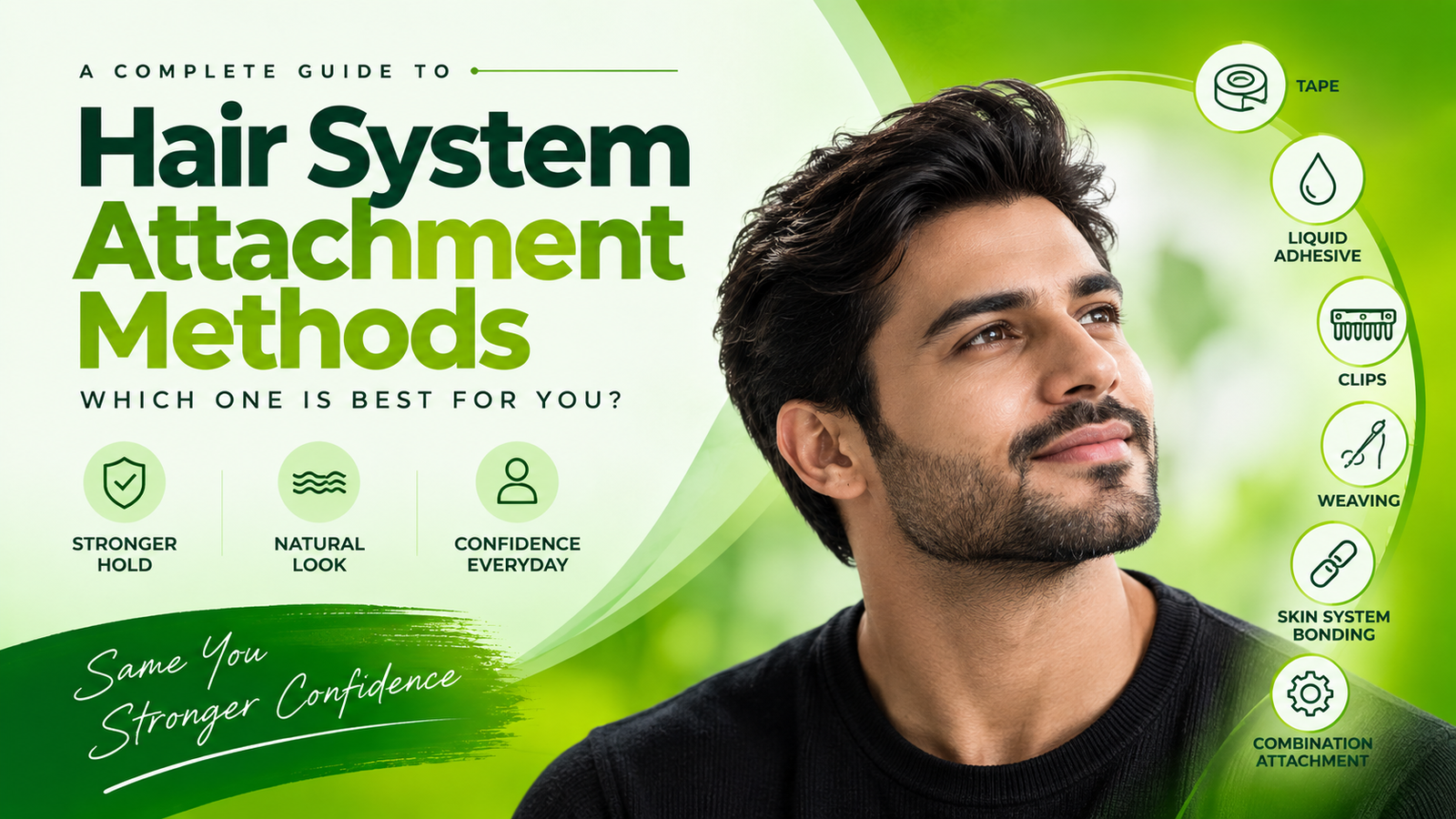
THE ONE QUESTION EVERY NEW CLIENT ASKS
Choosing the right hair system attachment method is one of the most important decisions when getting a hair system. The color is right, the density looks natural, and the base matches your scalp. Then the stylist asks one question that stops most people cold: how do you want it attached?
Suddenly, you are picturing swimming pools, sweaty gym sessions, and that one wedding where you cannot afford a single lifted edge. You may wonder whether it will hold through a Hyderabad summer. Can it survive a monsoon commute in Warangal? And what happens if it comes loose during a client meeting?
Here is the good news. The best hair system attachment method is not a mystery or a guessing game. It comes down to your scalp, your routine, and how often you are willing to visit the studio for maintenance. Once you know how each method actually works, the choice gets a lot simpler.
This guide walks through every major hair system attachment method used today, compares them side by side, and points out the mistakes that cause most of the complaints we hear at the studio. If you are still deciding whether a non-surgical hair replacement system is right for you at all, that is worth reading first.
QUICK ANSWER
There is no single best hair system attachment method for everyone. Tape and liquid adhesive give the strongest hold for daily wear and are the most common choice for men who want a natural, undetectable finish. Clip attachment suits people who want to remove the system nightly and avoid any adhesive on the scalp. Weaving and skin-system bonding suit long-term wearers who want minimal touch-up visits. The right hair system attachment method depends on your skin sensitivity, activity level, and how much upkeep you want to commit to.
WHAT ACTUALLY HAPPENS WITH A HAIR SYSTEM ATTACHMENT METHOD
Every hair system attachment method solves one basic problem: keeping a thin, breathable base secure against your scalp. The goal is a natural look without bulk or discomfort. Adhesive methods create a bond between the base and your skin. Tape bonds when you press it into place. Liquid adhesive is applied and allowed to become tacky before the system is fitted.
Mechanical methods skip chemistry altogether. Clips grip onto your remaining hair like a hair extension. With weaving, your natural hair is braided into tracks. The system is then sewn onto those tracks.
In humid cities like Hyderabad or Kurnool, sweat and natural oil can soften the edges of a tape or adhesive system. This does not mean the attachment has failed. It may simply mean the adhesive is nearing the end of its wear cycle. That is normal and does not necessarily indicate a poor application.n. If you already deal with sensitive skin, the American Academy of Dermatology is a good starting point for general guidance on adhesive-related skin reactions before your first appointment.
WHY THIS MATTERS MORE THAN PEOPLE REALIZE
Choosing the wrong hair system attachment method is more than a comfort issue. It can affect your confidence too. Someone who uses long-hold liquid adhesive for heavy manual work may experience lifting, itching, or anxiety about the hairline. Someone who chooses lightweight tape for swimming may find that the method does not suit their routine.
Choose the right attachment method and the system becomes something you barely notice. Choose the wrong one and every mirror check can become a source of stress.
6 HAIR SYSTEM ATTACHMENT METHODS COMPARED

1. DOUBLE-SIDED TAPE
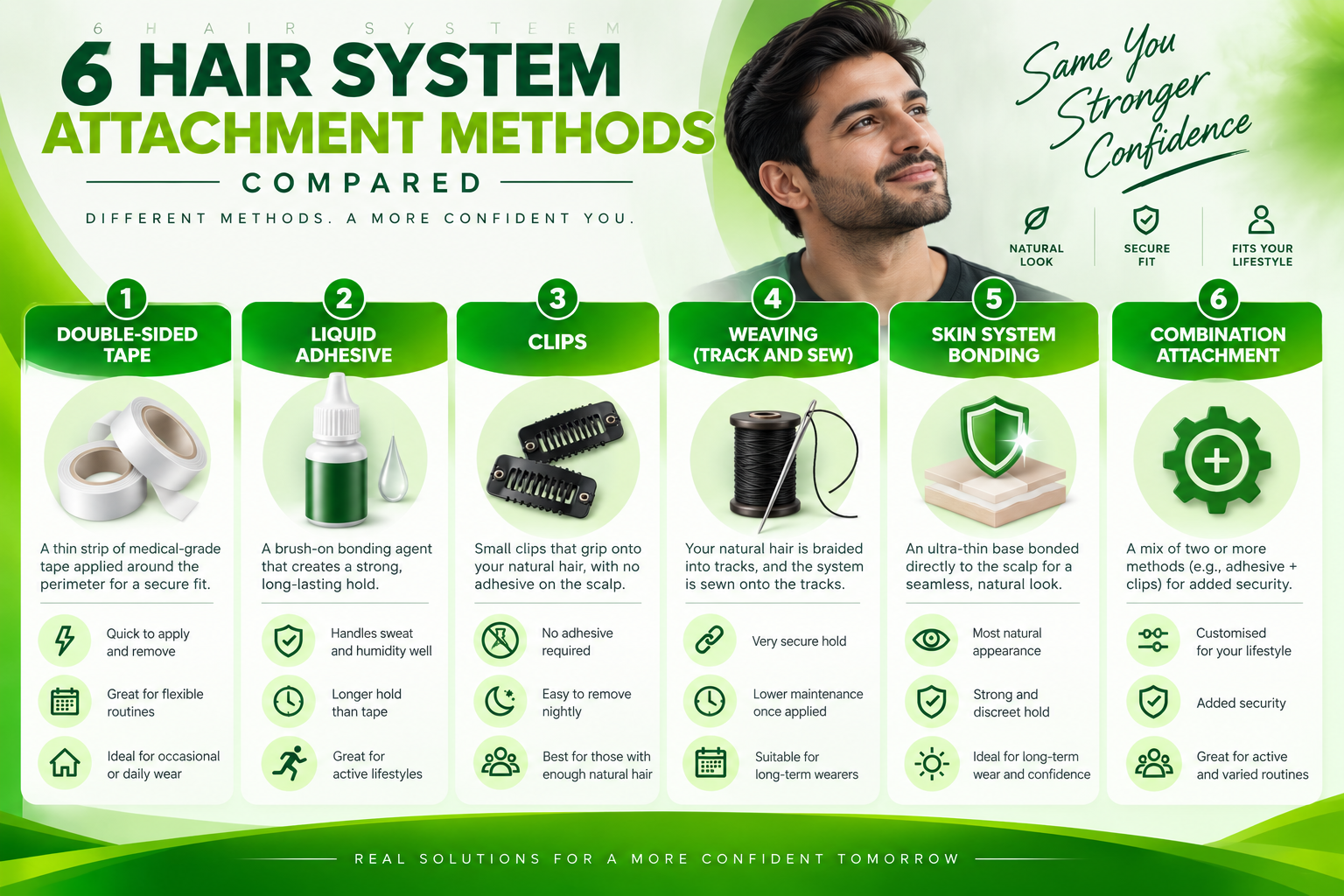
What it means: A thin strip of medical-grade adhesive tape applied around the perimeter of the base, pressing the system directly onto the scalp.
Why it matters: Tape is the fastest attachment method to apply and remove, which makes it popular with clients who want flexibility without a long studio visit every time.
How to do it: The stylist first cleans the scalp. Next, they cut the tape to match the base perimeter. The system is then pressed down section by section. Finally, the front hairline is blended with a fine-tooth comb
Example: One client who works a desk job in Bangalore switched from liquid adhesive to tape purely because he wanted to remove his system every night rather than commit to a two to three week attachment cycle.
Pro tip: Keep a small tape refill kit at home for quick touch-ups at the crown, where lifting shows up first.
2. LIQUID ADHESIVE
What it means: A brush-on bonding agent that cures into a strong, semi-permanent seal between the base and the scalp.
Why it matters: Liquid adhesive generally lasts longer than tape. It also handles sweat and humidity well. For this reason, it can suit people with physically active jobs.
How to do it: The adhesive is applied in a thin, even layer along the perimeter, left to become tacky, and the base is pressed on and held firm until it sets fully.
Example: Think of it the way a wet-set paint job cures firmer than a quick spray coat. It takes a little longer to bond, but the result stands up better to daily wear.
Pro tip: Ask your stylist about the drying window before you leave the chair. Rushing out too soon is the single biggest cause of early lifting with this method.
3. CLUTCHING WITH CLIPS
What it means: Small metal or fabric-covered clips sewn into the base that grip onto your natural remaining hair to hold the system in place.
Why it matters: There is zero adhesive contact with the scalp, so this is the go-to hair system attachment method for anyone with skin sensitivities or a preference for daily removal.
How to do it: The system is positioned over the scalp, and each clip is snapped shut around a small section of your own hair near the base, usually along the sides and back where enough natural hair remains.
Example: A client from Kurnool who runs a small retail shop uses clips because he wants to take the system off every night, the same way he would take off a watch.
Pro tip: Clips work best with at least a short length of natural hair to grip. If your hair is very thin at the attachment points, ask about a combination method instead.
4. WEAVING (TRACK AND SEW)
What it means: Your remaining natural hair is braided into thin tracks, and the hair system is sewn directly onto those tracks with thread.
Why it matters: Weaving is one of the most secure non-adhesive attachment methods, holding through workouts, swimming, and sleep without loosening.
How to do it: A stylist braids the natural hair into rows across the scalp, positions the system over the braids, and stitches the perimeter into the tracks using a curved needle and matching thread.
Example: It works much like sewing a patch onto fabric. The stitching does the holding, not glue.
Pro tip: Tracks need to be redone every four to six weeks as your natural hair grows out from the roots, so factor that into your maintenance schedule.
5. SKIN SYSTEM BONDING
What it means: An ultra-thin polyurethane or silicone base bonded to the scalp with a specialized adhesive designed for prolonged wear.
Why it matters: This hair system attachment method gives the most realistic scalp-to-skin appearance and is popular for clients who want the front hairline to be completely undetectable.
How to do it: The scalp is prepped and degreased, adhesive is applied to the ultra-thin base, and the system is pressed and rolled into place to remove any air pockets before the edges are sealed.
Example: One client preparing for his wedding switched to a skin system three weeks ahead of the event specifically for close-up photography, where thicker bases tend to show a visible line.
Pro tip: Skin systems need more frequent cleaning around the perimeter since the thinner material shows oil buildup faster than a lace or mono base.
6. COMBINATION ATTACHMENT
What it means: Using two methods together, most often tape or adhesive around the front hairline paired with clips at the back and sides.
Why it matters: Combining methods spreads the workload so no single attachment point is under constant stress, which is useful for very active lifestyles.
How to do it: The perimeter is set with adhesive so the hairline stays undetectable, while the back sections use clips for a quicker at-home removal option when needed.
Example: A gym-goer who trains six days a week uses this setup so the front stays photo-ready while the back can be loosened slightly after intense workouts.
Pro tip: Tell your stylist about your weekly routine in detail, including gym days and swim days, so the combination is built around your actual week rather than a generic default.
COMMON HAIR SYSTEM ATTACHMENT METHOD MISTAKES
Mistake: Choosing a method based on price alone. Impact: Ends up reattaching more often than planned, costing more over time. Solution: Match the method to activity level first, budget second.
Mistake: Skipping the scalp-cleaning step before reattachment. Impact: Oil residue weakens the bond and shortens wear time. Solution: Always degrease the scalp fully before any tape or liquid adhesive application.
Mistake: Leaving tape or adhesive on well past its recommended cycle. Impact: Increases the risk of scalp irritation and buildup. Solution: Stick to the two to three week reattachment window for tape and adhesive methods.
Mistake: Using clips on very thin remaining hair. Impact: The clips slip or pull uncomfortably. Solution: Ask about a skin system or adhesive method if natural hair at the attachment points is sparse.
Mistake: Swimming or heavy sweating right after a fresh application. Impact: The bond has not fully cured and can lift prematurely. Solution: Wait the full curing window your stylist recommends before water exposure or intense exercise.
BEST PRACTICES FOR CHOOSING A HAIR SYSTEM ATTACHMENT METHOD
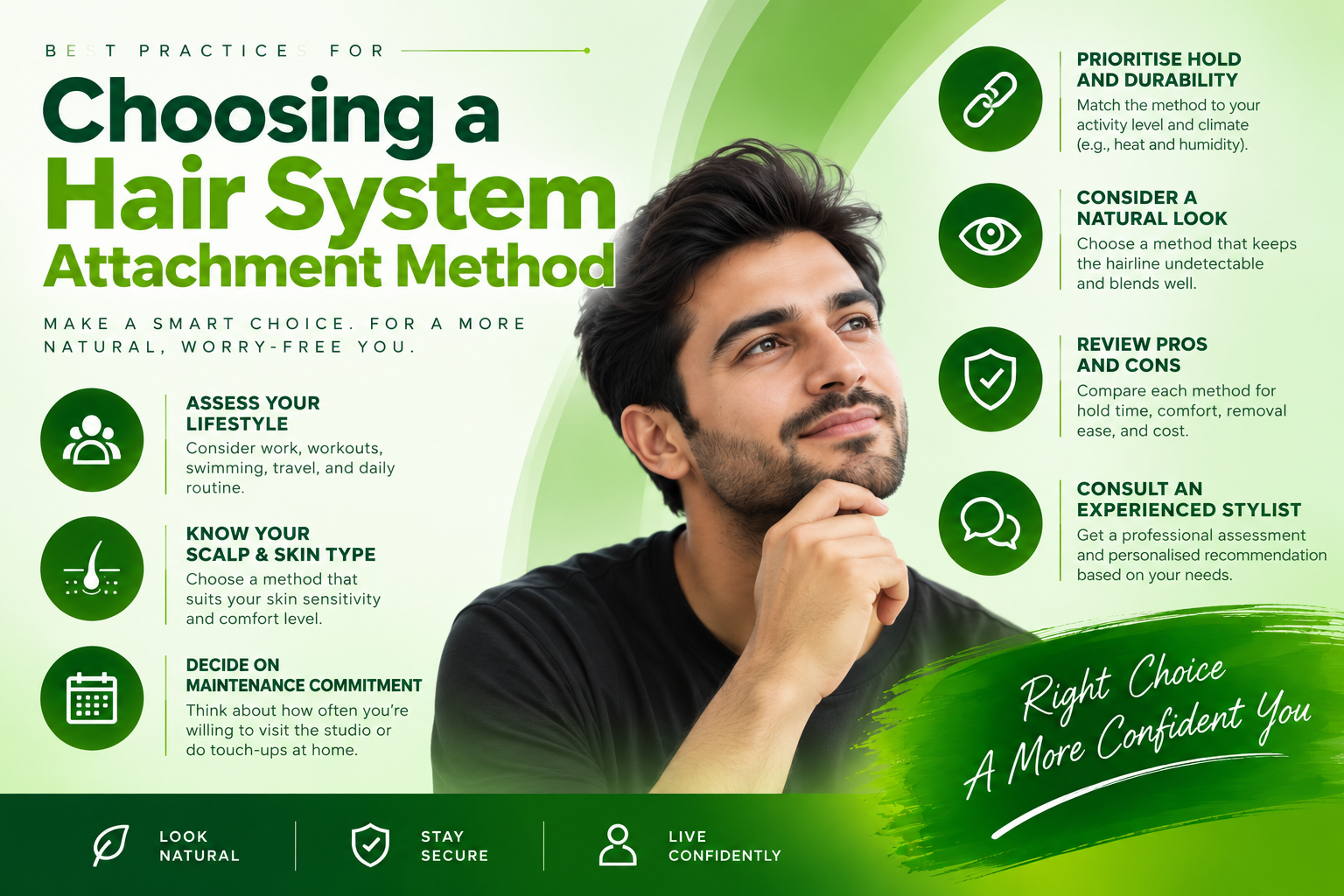
Talk through your actual weekly routine with your stylist, including gym days, swimming, and travel, before deciding on a method.
Ask to see and feel a sample of each base and adhesive type rather than choosing from a photo alone.
Keep a fixed reattachment schedule instead of waiting until the system feels loose.
Tell your stylist about any skin sensitivity or history of reactions before your first application.
Reassess your attachment method every few months as your lifestyle or climate exposure changes.
HAIR SYSTEM ATTACHMENT METHODS: TOOLS AND PRODUCTS COMPARISON
| Attachment Type | Best For | Relative Hold Duration | Suitability for Active Lifestyles |
|---|---|---|---|
| Double-sided tape | Frequent removal, beginners | Short to medium | Moderate |
| Liquid adhesive | Daily wear, natural finish | Medium to long | High |
| Clips | Sensitive skin, nightly removal | Not applicable (removable daily) | Moderate |
| Weaving | Long-term secure hold | Long | High |
| Skin system bonding | Undetectable hairline, photos | Medium to long | High |
| Combination | Very active routines | Varies by section | Very high |
Actual reattachment intervals and product pricing vary by studio, brand, and location, so treat this as a general comparison rather than a fixed price list.
REAL LIFE CASE STUDY
Situation: A client in his early thirties came in wearing a hair system attached with liquid adhesive, applied at a different salon, and complained that the front edge lifted within four days every single cycle.
Challenge: He was training at the gym six days a week and swimming twice weekly, well beyond what a standard adhesive cycle is built to handle, but nobody had asked about his routine before choosing the method.
Action: We switched him to a combination attachment, adhesive at the front hairline and clips along the sides and back, and moved his reattachment schedule to align with his gym week rather than a fixed calendar date.
Result: His front hairline held cleanly through eight weeks of the new schedule with zero unplanned lifting, and his reattachment visits dropped from every four days to a controlled two-week cycle.
EXPERT TIPS FOR A LONG-TERM HAIR SYSTEM ATTACHMENT
Build a real conversation with your stylist about your week, not just your hair. The attachment method that works for a desk job will not survive a construction site, and the reverse is just as true.
Do not assume your first attachment method is permanent. Skin changes with seasons, and a method that worked fine in winter can behave differently once humidity climbs in the monsoon months.
Keep a small travel kit with your specific adhesive or tape brand if you travel often, since not every studio stocks the exact same products.
FREQUENTLY ASKED QUESTIONS
Which hair system attachment method lasts the longest? Liquid adhesive and skin system bonding typically hold the longest between visits, often two to three weeks depending on your skin and activity level.
Can I swim with a taped hair system? Yes, once the tape has fully set, though salt water and chlorine exposure will shorten how long the bond lasts before your next reattachment.
Does any attachment method damage natural hair? Weaving and clips can cause tension on natural hair if applied too tightly or left in too long without adjustment, so proper spacing matters.
Is clip attachment less secure than adhesive? For daily removal it works well, but it is not built for swimming or intense workouts the way adhesive or a combination method is.
How often do I need to reattach a tape system? Most clients return every one to two weeks, though oilier skin types may need more frequent visits.
Can I switch attachment methods later? Yes, many clients change methods as their lifestyle, climate, or comfort preferences shift over time.
Does skin system bonding suit humid climates like Hyderabad? It can, but the thinner base needs more frequent cleaning in humid conditions to prevent oil buildup along the edges.
Is any hair system attachment method completely waterproof? No method is fully waterproof indefinitely, but liquid adhesive, skin bonding, and combination methods handle water exposure the best.
What is the most affordable attachment method to maintain? Tape tends to be the most budget-friendly for at-home touch-ups, though it usually needs more frequent studio visits than adhesive.
Can sensitive skin handle any adhesive method? Many sensitive-skin clients do fine with adhesive once the right hypoallergenic product is selected, but clips remain the safest option if reactions have happened before.
KEY TAKEAWAYS
Match your hair system attachment method to your actual weekly routine, not just your budget.
Tape and liquid adhesive give the most natural finish for daily wear.
Clips are the better choice if you want to remove the system every night.
Weaving and skin bonding suit clients who want longer stretches between studio visits.
Combination attachment spreads the load for very active lifestyles.
Reassess your method whenever your routine, climate, or skin sensitivity changes.
CONCLUSION
Choosing the right hair system attachment method comes down to three honest answers: how active you are, how sensitive your skin is, and how often you are willing to sit in the stylist’s chair. Once those three answers are clear, the method mostly picks itself.
Clients who take the time to walk through their actual week with their stylist end up with systems that hold reliably and disappear into their daily life. Clients who pick based on a photo or a friend’s recommendation are usually the ones back in the chair within days, dealing with lifted edges and avoidable irritation.
READY FOR AN ATTACHMENT METHOD THAT ACTUALLY FITS YOUR WEEK?
If your current hair system keeps lifting, itching, or slipping before its scheduled reattachment, the method is very likely the problem, not the system itself. Book a consultation with our team and we will walk through your routine, your skin, and your schedule to match you with the attachment method built for how you actually live.
Visit needshairstudio.com or call your nearest branch to book a fitting before your next reattachment is due.