THE INVITATIONS ARE OUT, AND YOUR HAIRLINE KNOWS IT
If a wedding is on your calendar this winter, hair replacement for wedding season has probably crossed your mind more than once. The date is fixed, the guest list keeps growing, and every photo will sit in the family album for decades. Hair that feels uncertain makes all of that heavier.
The pressure behind hair replacement for wedding season is real for grooms, but it also reaches fathers, brothers and friends who will stand in the front row of the photographs. Everyone wants to look like themselves on the day, only a little more rested.
Here is the good news. A well planned hair system can look natural in close-up photos, under bright lights and through a full day of ceremonies. The key word is planned. Weddings reward people who start early, and they punish people who leave every decision for the last week.
This guide explains what a wedding day demands from your hair, how to build a timeline for hair replacement for wedding season, and seven practical steps that keep you confident from the first ritual to the last photo.
QUICK ANSWER: SHOULD YOU TRY HAIR REPLACEMENT FOR WEDDING SEASON?
Yes, if you start early. Hair replacement for wedding season works best when you begin two to three months before the date, because a custom hair system needs time for design, fitting and a proper wear-in period. Plan the style around your wedding outfit, test it in real conditions and book a final touch up in the last week. Never start a brand new look in the final few days, since you will have no room to fix anything.
WHAT A WEDDING DAY ACTUALLY DEMANDS FROM YOUR HAIR
A wedding is not an ordinary day for a hair system, which is why hair replacement for wedding season needs its own plan. The day is long, warm, crowded and full of contact. Four things stand out.
First comes heat and sweat. Mandap lights, packed halls and a baraat dance can leave your scalp damp for hours, and moisture is the main enemy of an adhesive bond.
Next comes contact. Elders bless you with a hand on your head, friends hug you, and someone will lift a garland over your head. Each moment puts pressure on the hairline.
Then come headwear and cameras. A sehra or safa sits on your hair for hours, and close-up flash photos show every edge.
Finally, many ceremonies involve a sacred fire or lit diyas. Many hairsprays are flammable, so styling products and flames need a safe distance.
WHY HAIR REPLACEMENT FOR WEDDING SEASON NEEDS A TIMELINE
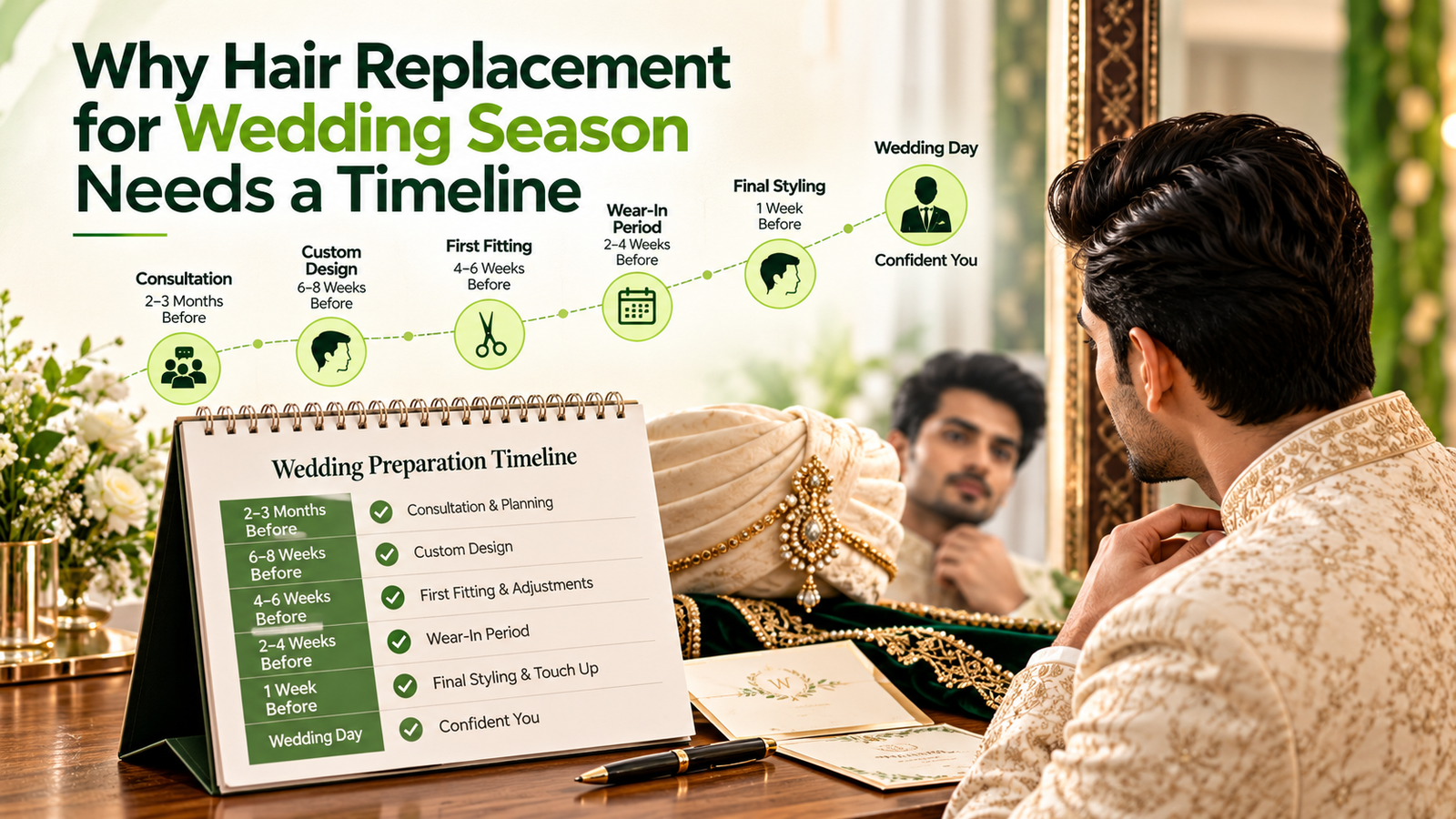 The main wedding season in much of India runs from roughly November to February, and appointments fill up fast. Most stress around hair replacement for wedding season comes from compressed time, not from the hair system itself.
A custom unit takes weeks to make, a first fitting needs adjustments, and you need a stretch of normal days to learn how it behaves. Skip any of those steps and you carry the risk onto the wedding stage.
A timeline fixes this. Once you know the date, you can count backwards through consultation, fitting, wear-in, final styling and touch up. The tips below follow that order.
7 ESSENTIAL TIPS FOR HAIR REPLACEMENT FOR WEDDING SEASON
Follow these in order, because the first three decide how smooth everything else feels.
1. PLAN YOUR HAIR REPLACEMENT FOR WEDDING SEASON TWO TO THREE MONTHS AHEAD
What it means Count backwards from the wedding date and book your consultation as soon as the date is fixed.
Why it matters A custom hair system is made for your head, so it takes weeks to prepare. A late start squeezes the fitting and the wear-in into a few days, and that is when mistakes happen.
How to do it Visit a stylist as soon as the date is confirmed. Share your wedding date, your outfit plans and the ceremonies you will attend. Ask for a written timeline that shows each step and its date.
Example Picture a groom who confirms a February wedding in September. He has time for a consultation, a fitting, a wear-in and two adjustments, all without hurrying.
Pro tip If you are not sure why you are losing hair, see a dermatologist first. The American Academy of Dermatology lists medicines, hormones, stress and poor nutrition among the common causes.
2. DESIGN THE STYLE AROUND YOUR WEDDING LOOK
What it means Your hair system has to work with the whole outfit, including the sehra, safa or turban, and not only with the mirror at home.
Why it matters Headwear changes how hair sits, and cameras change how hair looks. A style that works in daylight can look different under flash.
How to do it Tell your stylist which headwear you plan to wear. Bring photos of the look you like. Ask for a soft, natural hairline instead of a very dense one, because a soft hairline photographs more naturally.
Example Think of a groom in a heavy safa. His stylist keeps the sides neat and the top flexible, so the safa sits comfortably without crushing the style.
Pro tip Take your headwear to the fitting, so your stylist can see how it presses.
3. WEAR IT IN WELL BEFORE THE FUNCTIONS
What it means Wear the hair system for several weeks before the first function, so it feels like your own hair by then.
Why it matters New hair makes you touch your head and check mirrors. You do not want that habit starting on the wedding stage. Family and friends also get used to the new look, so nobody makes a fuss on the day.
How to do it Wear it daily through normal routines, including work, sleep and exercise. Learn how it feels in heat, after a wash and after a long day. Report any lifting edge at your next visit.
Example Imagine a groom who wears his system for six weeks. By the haldi he has stopped thinking about it, and his cousins no longer comment.
Pro tip Attend one real social event, such as a family dinner, as a dress rehearsal before the wedding week.
4. PREPARE FOR EACH CEREMONY, FROM HALDI TO PHERAS
What it means Every function stresses your hair in its own way, so prepare for each one separately.
Why it matters Haldi brings turmeric paste and water, the sangeet and baraat bring dancing and sweat, and the pheras bring long hours near a flame. One plan will not cover all of them.
How to do it Ask your stylist how to protect the system on the haldi day, including how to keep paste away from the hairline. Keep a clean cotton cloth ready for sweat at the sangeet and baraat. Skip aerosol hairspray near any flame, because many sprays are flammable.
Example Picture a groom who dances through the baraat for an hour. A friend hands him a cloth, he blots his temples instead of rubbing, and the bond stays put.
Pro tip Write a one page schedule of functions with a note beside each one, and give a copy to your best man.
5. HANDLE THE SEHRA, SAFA AND GARLAND GENTLY
What it means Anything that goes over your head, from the sehra to the varmala, can drag across the hair system.
Why it matters Pulling at the front edge lifts a bond faster than anything else. Weddings contain several of these moments, and each one happens in front of a camera.
How to do it Ask the person tying the safa to work slowly and avoid pulling it across the front edge. Bow your head slightly when the varmala goes on, and have the other person lift it over you instead of dragging it. If you arrive on a bike, read our guide to wearing a helmet over a hair system so the front edge survives the ride.
Example Think of pulling a sweater over your head. Go slowly and it slides over, but rush and it snags the hairline.
Pro tip Practise the garland lift once with a family member before the wedding, so nothing about it is a surprise.
6. BOOK YOUR FINAL HAIRCUT AND TOUCH UP IN THE LAST WEEK
What it means Schedule one last visit in the week before the first function for a haircut, a blend and a bond check.
Why it matters Small edges and growth lines show up in photos, and a fresh check catches them. A visit too close to the event leaves no time to fix surprises, while a visit too early lets the hair look tired.
How to do it Book the visit for the week before the first function. Ask the stylist to check the edges and trim the surrounding hair. Avoid new products or treatments after that visit.
Example Imagine a groom whose first function is on a Sunday. He books his touch up for the Monday before, so he has six days to spot and fix anything.
Pro tip Never book the touch up for the morning of the wedding, because rushing leads to mistakes.
7. BUILD A WEDDING DAY KIT AND A BACKUP PLAN
What it means Pack a small kit and name one person who knows what to do if something shifts.
Why it matters Small problems stay small when someone can fix them quickly. Without a plan, a lifted edge becomes a distraction during the most photographed hours of your life.
How to do it Ask your stylist at Needs Hair Studio what to carry, then pack a clean cotton cloth, a soft comb and a small mirror. Save your stylist’s phone number on your best man’s phone. Agree on a quiet spot where you can fix things between rituals.
Example Think of a spare tyre. You hope never to use it, but you are glad it is there on a long drive.
Pro tip Show the kit to a groomsman before the day, so he knows where it is.
MISTAKES TO AVOID WITH HAIR REPLACEMENT FOR WEDDING SEASON
| Mistake | Impact | Solution |
|---|---|---|
| Starting in the last month | Rushed fitting and no wear-in | Book as soon as the date is fixed |
| Trying a brand new style on the wedding day | Surprises and last minute stress | Wear the final style for weeks first |
| Ignoring the headwear | Pressure at the front edge | Bring the safa or sehra to the fitting |
| Using aerosol spray near a flame | Fire risk | Skip aerosol sprays and keep a safe distance |
| Wiping sweat hard | Lifted edges | Blot gently with a clean cotton cloth |
BEST PRACTICES FOR HAIR REPLACEMENT FOR WEDDING SEASON
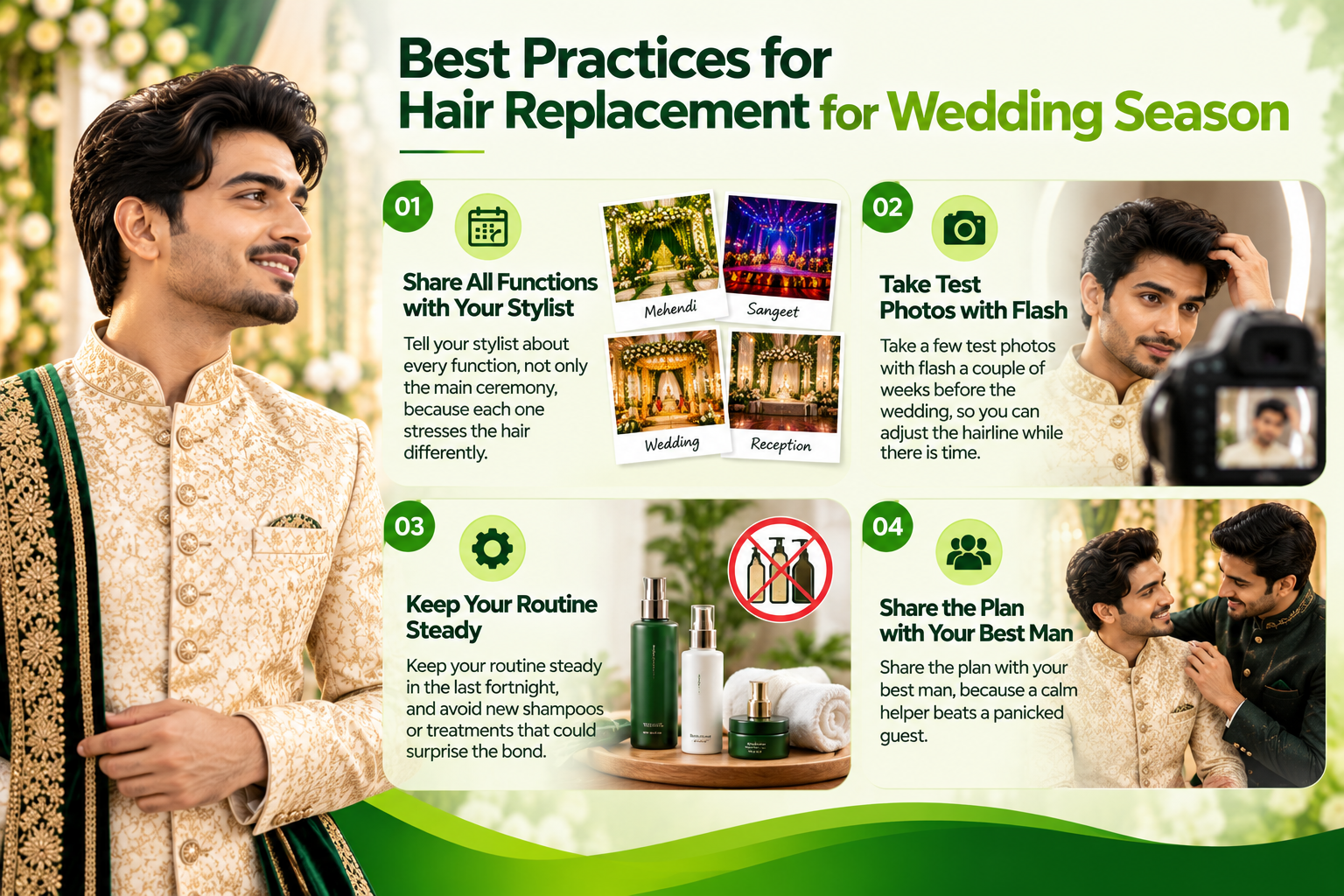 Four habits keep hair replacement for wedding season calm and predictable.
Tell your stylist about every function, not only the main ceremony, because each one stresses the hair differently.
Take a few test photos with flash a couple of weeks before the wedding, so you can adjust the hairline while there is time.
Keep your routine steady in the last fortnight, and avoid new shampoos or treatments that could surprise the bond.
Share the plan with your best man, because a calm helper beats a panicked guest.
TOOLS AND PRODUCTS COMPARISON
These small items support hair replacement for wedding season on the day itself.
| Item | Best For | When to Use |
|---|---|---|
| Clean cotton cloth | Blotting sweat without rubbing | Sangeet, baraat and long rituals |
| Soft comb | Tidying the surrounding hair | Between rituals and before photos |
| Small mirror | Checking the front edge | Before photographs |
| Stylist’s phone number | Quick advice if something shifts | Any time during the functions |
| Printed function schedule | Keeping helpers in the loop | Shared with the best man before the first function |
Ask your stylist whether your attachment method needs anything extra in the kit.
CASE STUDY: HAIR REPLACEMENT FOR WEDDING SEASON IN PRACTICE
This is an illustrative scenario about hair replacement for wedding season, built from questions grooms often ask, not a named client.
Situation A groom in Hyderabad fixes his wedding for February and decides in September to explore a hair system.
Challenge He worries about the sehra, a long baraat dance and close-up photos.
Action He books a consultation straight away and wears the system for six weeks before the first function. He brings his safa to a fitting and books a touch up for the week before the wedding.
Result He spends the haldi and the pheras enjoying the day instead of checking his hairline, and the photos show a natural look.
EXPERT TIPS FOR HAIR REPLACEMENT FOR WEDDING SEASON AND BEYOND
Decide early how much you want to tell people. Some grooms share it with close family, and others keep it private. Either choice works, but make it before the wedding week so no comment catches you off guard.
Keep your care routine steady after the wedding too. Honeymoon trips bring pools, beaches and travel, so ask your stylist for a plan before you leave.
Treat hair replacement for wedding season as the start, not the finish. The same care that carried you through the functions keeps your hair system looking good in the years of photos that follow.
FREQUENTLY ASKED QUESTIONS ABOUT HAIR REPLACEMENT FOR WEDDING SEASON
TIMING AND PLANNING QUESTIONS
How early should I start hair replacement before a wedding? Two to three months is a sensible rule of thumb, because a custom unit needs design, fitting and a wear-in period. Your stylist will confirm the exact timeline for you.
Can I get a hair system in the last month? Sometimes, but you will have less time for adjustments. Book a consultation anyway, and let the stylist tell you what is realistic.
Should I tell my partner and family? That is entirely your choice. It can help to tell one or two close people, so they can help on the day.
What if my wedding has functions over several days? Plan for all of them. Share the full schedule with your stylist, so each function gets its own plan.
Is this only for grooms? No. Hair replacement for wedding season suits fathers, brothers and friends too, and the same timeline applies. If your hair loss comes from alopecia, read our guide to hair systems for alopecia.
WEDDING DAY QUESTIONS
Can I dance at my sangeet or baraat with a hair system? In most cases, yes, as long as the bond is fresh and fitted well. Blot sweat gently and take short breaks to let your head cool.
Can I wear a safa or sehra over a hair system? Yes. Bring the headwear to your fitting, and ask the person tying it to work slowly.
What if the edge lifts during the ceremony? Stay calm and step aside. Press a small lift gently flat with clean fingers, then ask your best man for the kit.
Can I use hairspray or gel? Use very little, and skip aerosol sprays near any flame because many are flammable. Ask your stylist which products suit your system.
Can I swim on my honeymoon? Ask your stylist before you travel, because chlorine and sea water need a care plan.
KEY TAKEAWAYS
- Start two to three months before the wedding, and book as soon as the date is fixed.
- Design the style around your outfit and headwear.
- Wear the system for several weeks before the first function.
- Prepare for each ceremony, from haldi to pheras, separately.
- Handle the sehra, safa and garland slowly, and keep aerosol sprays away from flames.
- Book the final haircut and touch up in the last week, never on the wedding morning.
- Pack a small kit and name one helper.
CONCLUSION
Hair replacement for wedding season is far less stressful than most people fear. A realistic timeline, a style built around your outfit, a proper wear-in and a small kit are usually all it takes to look and feel like yourself on the day.
Hair replacement for wedding season rewards early planning. The grooms who struggle are mostly the ones who started late and decided everything in a hurry. The grooms who enjoy every ritual are the ones who made the plan early and trusted it.
BOOK YOUR HAIR REPLACEMENT FOR WEDDING SEASON CONSULTATION
If you want hair replacement for wedding season that stays comfortable from the haldi to the last photograph, talk to a stylist at Needs Hair Studio. Share your wedding date, your outfit plans and your function schedule, and ask them to build a timeline that fits your calendar and your city.
Book a consultation with Needs Hair Studio this week, while there is still time to plan properly.