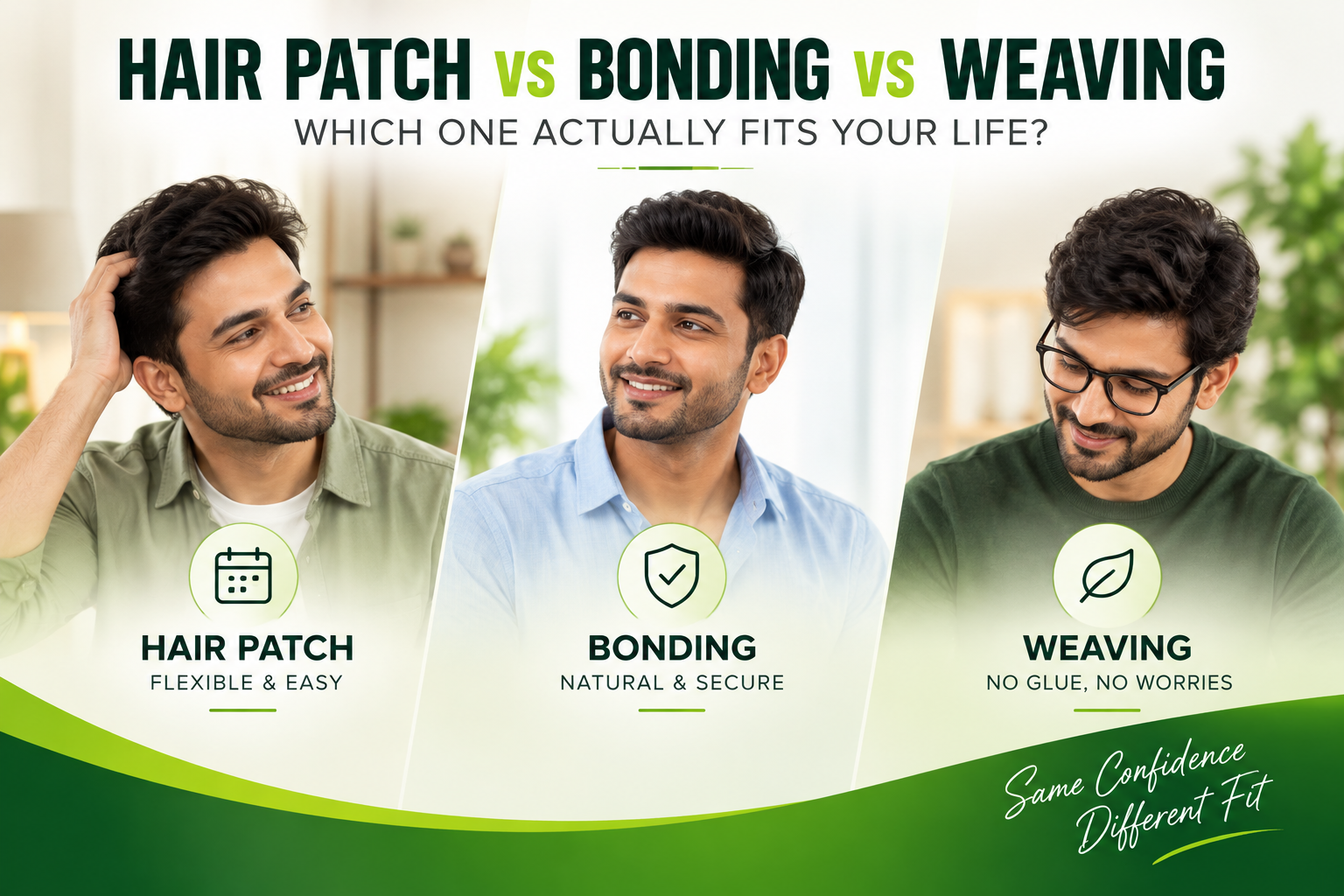
Bonding vs weaving is an important comparison when choosing how to attach a hair patch. Bonding uses medical adhesive to keep the system attached to the scalp, while weaving secures it to braided natural hair. Clips offer another flexible option for people who prefer to remove their hair patch daily.
Picking the wrong method can mean extra cost and another consultation. Some people want to remove their hair patch at night, like a pair of glasses. Others want to wear it continuously until their next touch up. Some people also prefer to avoid anything sticky on their scalp.
Here is the good news. Once you see how each method actually works, the choice mostly makes itself. This isn’t really a question of which one is “best.” It’s a question of which one fits how you sleep, sweat, swim and shower.
This guide walks through what a hair patch, bonding and weaving each actually mean, how they compare on cost and upkeep, and the mistakes people commonly make when choosing between them.”
BONDING VS WEAVING: QUICK ANSWER
When comparing **bonding vs weaving**, the biggest differences are attachment, maintenance and daily effort. Bonding uses medical adhesive to keep the system on your scalp. It can stay in place through showers, workouts and sleep. Most bonding setups need a touch up every three to four weeks.
Weaving uses thread to secure the system to braided natural hair. It does not require adhesive on the scalp. This can suit people who prefer to avoid glue or tape.
Clips offer a flexible option. You can put the system on in the morning and remove it before bed or swimming. All three methods can look natural when the hair color, density and base are matched correctly.
BONDING VS WEAVING: HOW DO THEY WORK?
A hair patch is the product itself. It usually has a thin polyurethane or lace base with hair strands attached to it. The system covers the area where you are thinning or bald. With clips, you can put the patch on in the morning and remove it at night.
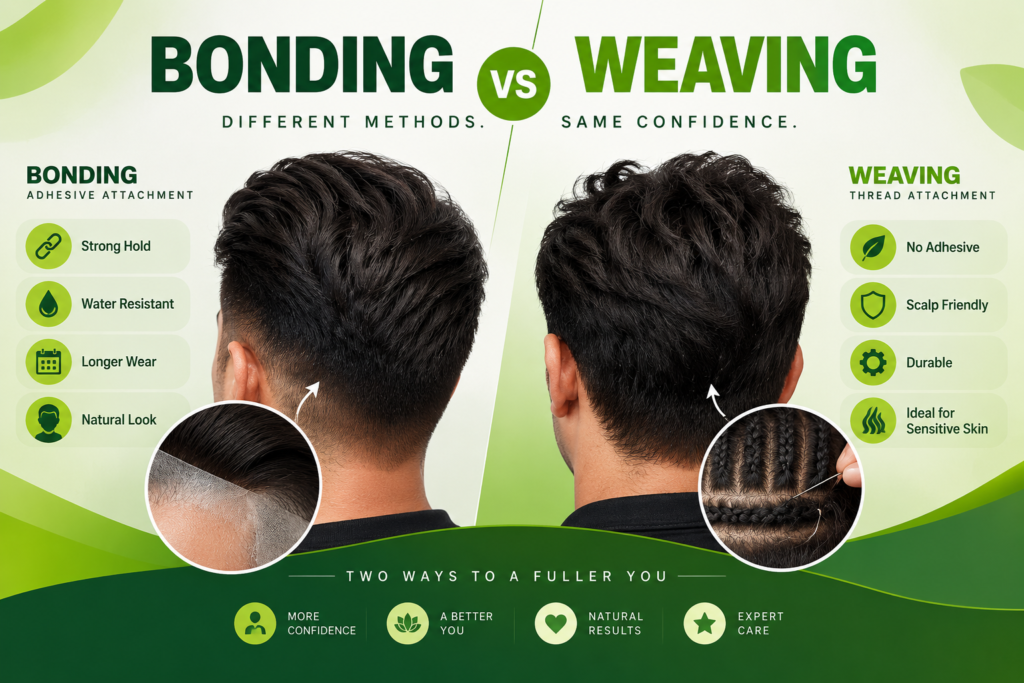
Bonding uses a medical-grade adhesive or double-sided tape. Your stylist applies the adhesive around the base and secures the patch directly to your scalp. The system can stay in place through showers, workouts and sleep. Your stylist removes it during the next touch up.
Weaving works without adhesive. Your stylist braids the natural hair around the thinning area into small, flat cornrows. The stylist then uses thread to secure the patch to those braids. This method keeps glue away from your scalp.
Each method offers a different experience. Clips give you flexibility, bonding provides continuous wear, and weaving avoids adhesive.
None of the three is more “real” than the others. They’re three different answers to the same question: how do you want this thing attached to your head.
BONDING VS WEAVING: WHY THE CHOICE MATTERS
A hair patch is the product itself: a base, usually a thin polyurethane or lace sheet, with hair strands attached to it, designed to sit over the area where you’re thinning or bald. It sits alongside medical treatments like minoxidil or hair transplant surgery as a non-surgical option, and on its own, a patch is just held on with small clips, the same way you’d clip in a hair accessory. You put it on in the morning and take it off at night.
BONDING VS WEAVING VS CLIPS: WHICH IS BEST?
1. CLIPS: FLEXIBLE HAIR PATCH ATTACHMENT
A patch uses small clips or combs to stay in place. You put it on and remove it yourself each day. No adhesive or thread is required.
Why it matters It’s the lowest commitment option. If you’re trying a hair system for the first time and aren’t sure you’ll like wearing one full time, this is how most people start.
You fix the patch in place each morning using the built-in clips. Style it as usual. Remove it before bed or before swimming.
Example A client at our Hyderabad studio picked a clip-based patch specifically because he wasn’t ready to commit to anything permanent. Two years later, he still wears the same style, just replacing the patch itself every several months.
Pro tip Keep a second clip-based patch as backup if you wear it daily. A clip can loosen or a strand can catch at the worst possible moment, and having a spare means you’re never caught without one.
2. BONDING: ADHESIVE ATTACHMENT
You fix the patch in place each morning using the built-in clips. Style it as usual. Remove it before bed or before swimming.
Why it matters This is the closest experience to having your own hair back. You shower with it, sleep in it, and don’t think about it until your scheduled touch up.
Your stylist applies adhesive around the base. They then press the patch onto your scalp and carefully match the hairline. The system stays bonded for roughly three to four weeks. Your stylist then lifts, cleans and reapplies it.
Example A regular client who used to wear a clip-based patch switched to bonding before a beach holiday, specifically so he wouldn’t have to worry about it during long days of swimming and outdoor activity.
Pro tip Ask your stylist for a small patch test with the adhesive before your first full bonding session, especially if you have sensitive skin. It takes ten minutes and can save you an uncomfortable few days later.
3. WEAVING: THREAD ATTACHMENT
What it means The patch is sewn onto small braids made from your own natural hair, using thread rather than any adhesive.
Why it matters No glue means no chemical contact with your scalp at all, which matters a lot for anyone who has had a reaction to adhesive, or simply prefers not to use it long term.
How it works Your stylist braids the hair around the thinning area into flat cornrows, then stitches the patch onto those braids so it sits securely without slipping.
Example A client who developed mild scalp irritation after a few months of bonding switched to weaving and reported no irritation at all afterward, since the base never touches his skin directly.
Pro tip Weaving needs a reasonable amount of natural hair around the area to braid into. If your hair loss is very advanced at the edges, ask your stylist whether weaving is realistic for your case before choosing it over bonding.
BONDING VS WEAVING: COMMON CHOOSING MISTAKES
Choosing based on price alone Impact: Ending up with a method that doesn’t match your actual lifestyle, then paying twice Solution: Decide based on how you shower, sleep, sweat and swim first, then look at cost
Going straight to bonding without an adhesive check Impact: Irritation, itching or early lifting in humid weather Solution: Ask for a small patch test before committing to a full bonding session
Picking weaving with too little natural hair left to braid Impact: A loose, uneven base that doesn’t hold securely Solution: Have your stylist assess your natural hair density around the area first
Switching methods too frequently Impact: Extra cost and inconsistent results as your scalp adjusts to different attachment types Solution: Give one method at least a full cycle, generally two to three months, before deciding to switch
BONDING VS WEAVING: HAIR PATCH ATTACHMENT METHODS COMPARISON
METHOD | ATTACHMENT | DAILY EFFORT | WATER AND SWEAT | SKIN CONTACT | BEST FOR Hair Patch (clip-based) | Clips, removable daily | High, put on and off yourself | Must remove before swimming | None | First-time wearers, flexible routines Bonding | Medical adhesive | Low, stays on continuously | Fully water and sweat resistant | Direct adhesive contact | Wanting a permanent, hands-off feel Weaving | Thread on braided hair | Low, stays on continuously | Fully water and sweat resistant | No chemical contact | Adhesive sensitivity, chemical-free preference
Exact cost varies by base material, hair type and how much area needs covering. For a realistic sense of what each option runs, see our breakdown of hair replacement cost in Hyderabad rather than going by a number you saw online.
BONDING VS WEAVING: REAL-LIFE CASE STUDY
Situation A client from Bangalore came in wanting the “most permanent” option without really knowing what that meant, and picked bonding on his first visit purely because it sounded like the strongest solution.
Challenge Within six weeks he noticed redness and mild itching around the hairline every time the weather turned humid, but kept reapplying the same adhesive because he assumed all bonding felt this way.
Action His stylist identified a mild adhesive sensitivity during a follow-up visit and moved him to weaving instead, using his own hair as the braided base.
Result The irritation disappeared completely, and he’s kept the same weaving setup for over a year with no discomfort, still getting the continuous, hands-off wear he originally wanted from bonding.
EXPERT TIPS FOR CHOOSING BETWEEN BONDING VS WEAVING
Choosing between bonding vs weaving becomes much easier when you consider your daily routine, scalp comfort and maintenance preferences. If you’re still new to all this, it’s worth reading 7 things nobody tells you before getting a hair system before you go in.
Be honest with your stylist about your routine. Someone who swims three times a week has very different needs from someone who just wants a natural look for the office.
If you’re unsure, start with the clip-based patch. It’s the easiest to reverse or upgrade from, and gives you real experience wearing a system before committing to anything permanent.
BONDING VS WEAVING: FREQUENTLY ASKED QUESTIONS
 Which is the most natural looking option?
 Which is the most natural looking option?
All three can look equally natural when the base, color and density are matched properly. The attachment method affects how it feels and holds, not how real it looks.
Is bonding painful?
No. Applying and removing the adhesive is a gentle process done by a trained stylist, though you may feel mild tightness on the scalp for the first few hours after a fresh bonding session.
Can I switch from one method to another later?
Yes. Many clients start with a clip-based patch and later move to bonding or weaving once they’re sure they want a continuous, hands-off setup.
Does weaving damage natural hair?
When done correctly with appropriately sized braids, weaving does not damage the hair, though very tight braiding done poorly can cause tension over time, which is why choosing an experienced stylist matters.
How long does each method last before maintenance is needed?
A clip-based patch mainly needs the base itself replaced every several months. Bonding and weaving both typically need a touch up every three to four weeks.
Is one option more expensive than the others long term?
Bonding and weaving involve regular touch up visits, so their ongoing cost tends to be higher than a clip-based patch, which has no attachment maintenance beyond the patch itself.
Can I swim with a clip-based patch?
Not securely. Clips are designed for everyday wear, not water exposure, so most people remove a clip-based patch before swimming. Our pool, beach and shower guide for hair systems covers what’s safe for each attachment type in more detail.
What if I have sensitive skin?
Weaving is usually the safer starting point since it involves no adhesive at all, though a patch test can also confirm whether a specific bonding adhesive works for you.
Do I need a certain hair length for weaving?
You need enough natural hair around the thinning area to braid into small, flat cornrows. Your stylist can tell you during consultation whether your current hair supports this.
BONDING VS WEAVING: KEY TAKEAWAYS
A hair patch, bonding and weaving all use the same kind of hairpiece, they just differ in how it’s attached Clip-based wear suits flexibility and a lower starting cost, bonding suits a permanent hands-off feel, weaving suits anyone avoiding adhesive Always get an adhesive patch test before a full bonding session if you have sensitive skin Weaving needs enough natural hair left to braid into, so it isn’t right for every hair loss pattern Give any method a full cycle before deciding to switch, rather than judging it in the first few weeks Your actual routine, not the price tag, should drive the decision
CONCLUSION
Bonding vs weaving vs clips doesn’t have a single winner because the best attachment method depends on how you actually live. There’s only the one that matches how you actually live, whether that means taking your hair off before a swim, forgetting about it until your next touch up, or avoiding adhesive altogether. Once you know that about yourself, the choice between a hair patch, bonding and weaving stops being confusing.
The clients who end up happiest are rarely the ones who picked the most expensive or most “permanent sounding” option. They’re the ones who told their stylist honestly how they live, and let that decide the method.
NOT SURE WHICH ONE FITS YOU?
The easiest way to decide is to see and feel all three in person rather than guess from a description. A proper consultation can assess your hair density, your skin, and your routine, and tell you exactly which method will actually work for you.
Book a consultation at Needs Hair Studio this week and walk out knowing which option is genuinely right for you, not just which one sounded right online.