YOU’VE HAD FORTY TABS OPEN FOR A WEEK NOW
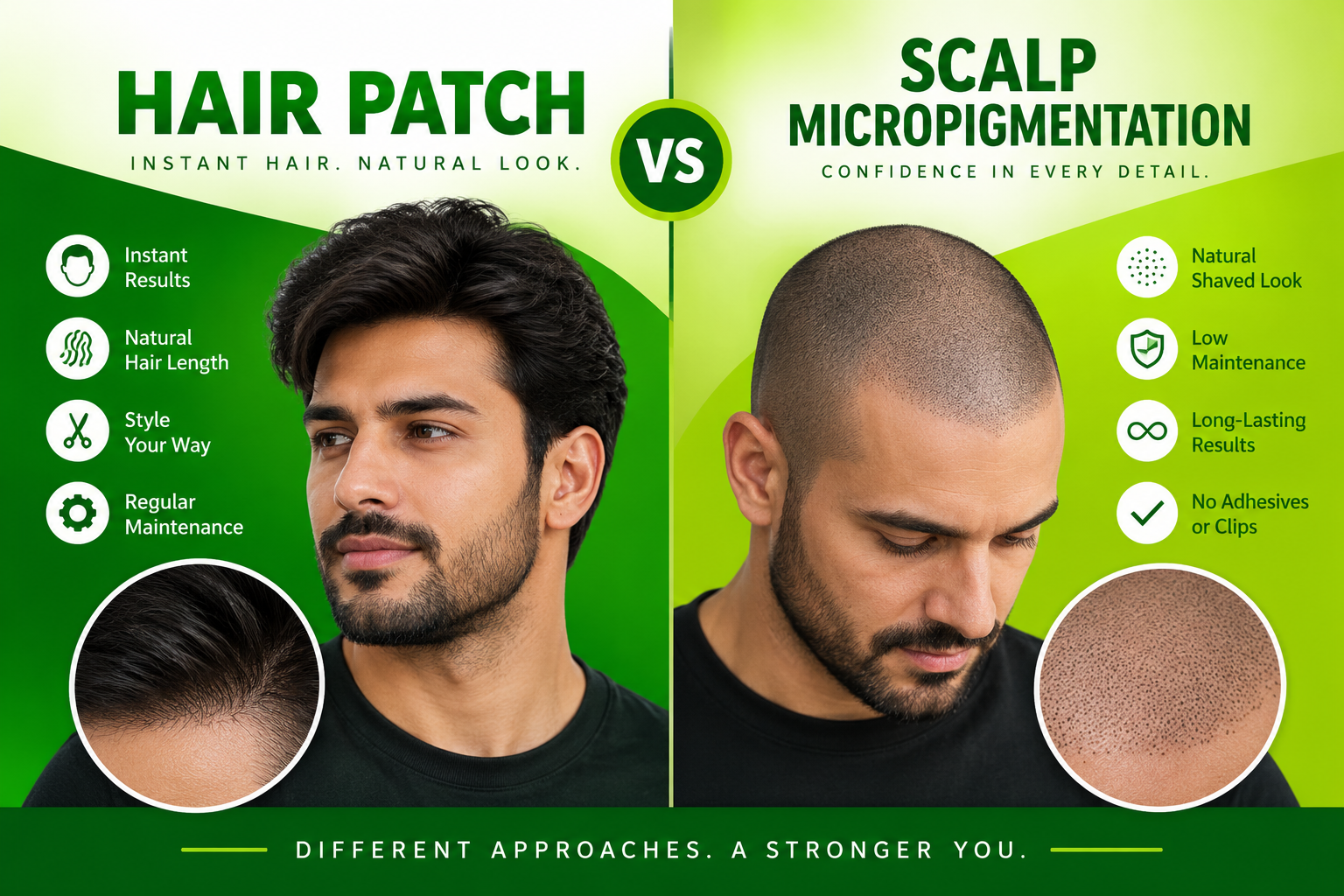
Hair patch vs SMP is one of the biggest decisions people face when looking for a non-surgical hair restoration option. You’ve watched the before-and-after reels until they blur together. One video shows a hairline stitched onto a base, full and thick within a single sitting. The next shows a shaved scalp turned into thousands of tiny dots that read as a buzz cut from across the room. Which one is actually you?
Hair patch vs scalp micropigmentation isn’t a small purchase you can return if it doesn’t work out. A hair patch changes how your hair looks and feels every single day. Scalp micropigmentation changes your scalp itself, and that part doesn’t wash out. Getting it wrong costs money, time, and a fair bit of confidence.
Here’s the good news. Once you line the two options up side by side against your own routine, climate, and budget, the choice usually stops feeling like a coin flip.
This guide walks through how each option actually works, seven questions worth asking yourself before you decide, the mistakes people make most often, and a straight comparison table so you’re not choosing blind.
HAIR PATCH VS SMP: QUICK ANSWER
For hair patch vs SMP, here’s the short version.
A hair patch attaches a hairpiece to your scalp with adhesive or clips. It can give you length and volume right away. However, it requires regular cleaning, adhesive changes, and reattachment.
Scalp micropigmentation works differently. It uses pigment to mimic the look of closely cropped or shaved hair. It does not produce actual growing hair.
Choose a hair patch if you want length and styling flexibility. Choose scalp micropigmentation if you prefer short hair and want less regular maintenance.
The right choice depends on your lifestyle, routine, and comfort with maintenance.
HAIR PATCH VS SMP: WHAT ACTUALLY HAPPENS TO YOUR SCALP
A hair patch sits on top of your scalp rather than inside it. Technicians knot individual strands into a lace or thin polyurethane base, then bond that base to your scalp with medical adhesive, tape, or clips, sometimes blending it into your own remaining hair at the edges. The base itself doesn’t grow or shed, so as your natural hair around it grows, the patch needs periodic removal, cleaning, and reattachment to stay convincing.
Scalp micropigmentation works differently. A technician deposits pigment at a controlled depth in the scalp using a fine needle, placing thousands of small dots that mimic the shadow of a hair follicle. There’s no base, no adhesive, and nothing sitting on the surface. Once the scalp heals, usually over a couple of weeks, the pigment stays put and behaves like the rest of your skin.
Humidity changes how each one behaves day to day. In a city like Hyderabad during the monsoon, a poorly matched adhesive can soften faster and lift at the edges by evening. Scalp micropigmentation doesn’t have that failure point, since there’s no bond holding anything on. That doesn’t make one option “better” on its own. It just means the two solve the same problem through completely different mechanics, and your climate is one of the variables worth factoring in before you pick.
HAIR PATCH VS SMP: WHY THIS MATTERS
Choose a hair patch without accepting the upkeep, and you end up with a piece that looks great in the first photo and worse every week after, until it sits in a drawer while you go back to hats and angles. Choose scalp micropigmentation while still hoping to grow your hair out someday, and you’re left with a result that only looks right if you commit to keeping it short forever.
Getting this decision right up front saves you from paying twice: once for the wrong option, and again for the one you should have picked initially. It also saves you the slower cost, which is losing confidence in a solution you chose in a hurry.
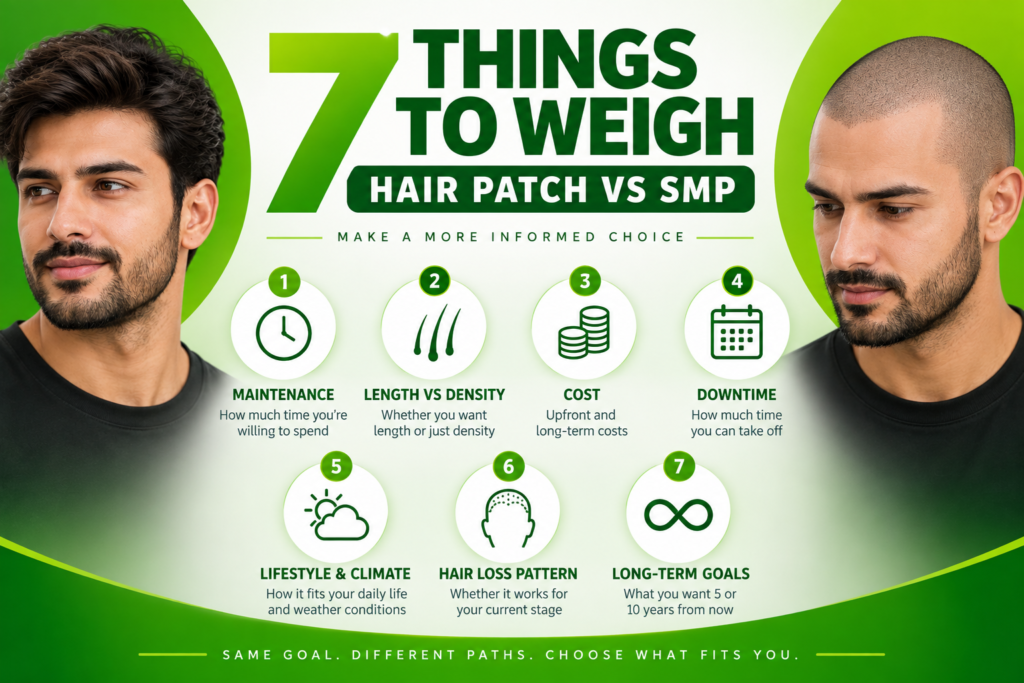
7 THINGS TO WEIGH: HAIR PATCH VS SMP

1. HOW MUCH TIME YOU’RE WILLING TO SPEND ON MAINTENANCE
What it means: A hair patch needs regular cleaning, adhesive top-ups, and reattachment visits. Scalp micropigmentation needs almost none of that once it heals.
Why it matters: Skipped maintenance is the single biggest reason patches start looking obviously fake.
How to decide: Be honest about whether you’ll actually show up for reattachment appointments every few weeks, or whether you’d rather deal with it once and move on.
Example: One client kept pushing his reattachment visits back by a few days each time, and within two months the front edge was visibly lifting in every photo his colleagues took.
Pro tip: Ask your provider for the exact reattachment interval in writing before you commit, not a rough estimate.
2. WHETHER YOU WANT LENGTH OR JUST DENSITY
What it means: A patch gives you actual hair length and styling options. Scalp micropigmentation only ever looks like closely cropped hair, never longer strands.
Why it matters: This is the one factor that can’t be adjusted later without starting over.
How to decide: Picture your hair a year from now. If you want to run your fingers through it, style it, or grow it out, that already rules one option out.
Example: A shaved-head look and a natural buzz cut are two different things up close, the same way a printed photo of grass looks flat next to real grass. Scalp micropigmentation gets you the printed photo, which is still convincing from a normal distance.
Pro tip: Ask to see healed scalp micropigmentation results on someone with your exact skin tone before you decide, not just the studio’s best photos.
3. YOUR CLIMATE AND ACTIVITY LEVEL
What it means: Sweat, humidity, and frequent swimming all put stress on the adhesive holding a patch in place.
Why it matters: A patch that looks perfect in a dry, air-conditioned studio can behave completely differently after a gym session in Warangal in May.
How to decide: Think about your actual week, not your ideal week. Gym four times, motorbike commute, outdoor work — all of that matters here.
Example: Someone who swims twice a week will get a different lifespan out of a patch than someone who mostly works at a desk, even with identical adhesive.
Pro tip: Ask specifically about humidity-rated or waterproof adhesive options if your routine includes regular sweat or swimming.
4. HOW PERMANENT YOU WANT THE DECISION TO BE
What it means: A patch can be removed at any point with no lasting change to your scalp. Scalp micropigmentation is designed to last for years and needs a removal procedure if you change your mind.
Why it matters: One of these choices keeps your options open. The other asks you to commit.
How to decide: If there’s any chance you’ll want to try a hair transplant or medical regrowth treatment later, a reversible option keeps that door open.
Example: Think of it the way you’d think about renting versus buying — a patch is the rental, easy to walk away from, and scalp micropigmentation is the purchase you plan to live with.
Pro tip: Ask your provider what removing scalp micropigmentation actually involves, in case your plans change five years from now.
5. YOUR STAGE AND PATTERN OF HAIR LOSS
What it means: Patches work well for covering larger bald areas or a full crown. Scalp micropigmentation works best when there’s already short or shaved hair for the pigment dots to blend into.
Why it matters: The wrong match here is the fastest way to end up with a result that looks obviously artificial.
How to decide: If you’re already comfortable keeping your hair very short, scalp micropigmentation has less work to do to look convincing. If you’re not, a patch does more of the heavy lifting.
Example: Someone with an advanced receding hairline but a full back and sides often gets a more natural result from scalp micropigmentation than someone with patchy, uneven thinning across the whole scalp.
Pro tip: Bring a clear photo of your hair from a year or two ago to your consultation. It helps the technician see how your pattern has actually progressed.
6. WHAT IT COSTS OVER YEARS, NOT JUST ON DAY ONE
What it means: A patch has a lower starting cost but ongoing costs for cleaning products, adhesive, and reattachment visits that add up every month.
Why it matters: The sticker price on day one rarely reflects what you’ll actually spend over two or three years.
How to decide: Ask for the recurring cost, not just the upfront one, and multiply it out over a realistic timeframe.
Example: It’s the same math as choosing between a cheaper printer and the cost of ink over time — the upfront number tells you almost nothing on its own.
Pro tip: Ask your provider for a written estimate covering the first two years, not just the first appointment.
7. HOW MUCH DOWNTIME AND DISCOMFORT YOU’LL ACCEPT
What it means: Fitting a patch is quick and generally painless. Scalp micropigmentation involves multiple sessions with a needle and mild soreness for a few days afterward.
Why it matters: If you have a big event coming up, the recovery window matters as much as the final look.
How to decide: Check how many sessions your provider recommends and build in a buffer before anything important.
Example: Most scalp micropigmentation plans run across two to four sessions spaced a week or more apart, so it’s rarely a same-week decision the way a patch fitting can be.
Pro tip: Avoid direct sun and swimming for the period your technician recommends after each session, since both can affect how the pigment settles.
COMMON HAIR PATCH VS SMP MISTAKES
| Mistake | Impact | Solution |
|---|---|---|
| Choosing a patch for the instant look without planning reattachment visits | Edges lift and become visible within weeks | Book a fixed reattachment schedule before you leave the first appointment |
| Getting scalp micropigmentation while still hoping to grow hair out later | Regret when longer hair no longer matches the healed pattern underneath | Ask to see mockups of how it looks with longer hair before committing |
| Skipping technician research for scalp micropigmentation | Pigment fades unevenly or shifts toward a blue-grey tone over the years | Look at healed results from at least a year out, not fresh photos |
| Ignoring your climate and activity level when picking a patch | Adhesive fails faster than expected in heat or humidity | Ask specifically about humidity-rated adhesive for your routine |
| Assuming one option is universally “better” | Choosing based on a trending video instead of your own daily routine | Match the choice to how you actually live, not how it looks on someone else |
HAIR PATCH VS SMP: BEST PRACTICES BEFORE YOU COMMIT

Talk to providers for both options before booking either one, even if you already have a favorite. Ask to see healed scalp micropigmentation results, since fresh photos always look better than they will in a year. Get the reattachment schedule and adhesive type for a patch in writing, along with what it costs to maintain. Ask whether a trial or removable option exists before you agree to anything permanent. Get any touch-up or warranty policy in writing rather than as a verbal promise at the consultation.
HAIR PATCH VS SMP: COST & MAINTENANCE COMPARISON
| Option | Best For | General Cost Tier | Maintenance Level |
|---|---|---|---|
| Clip-in hair patch | Occasional wear, testing the look before committing | Budget-friendly | High — clean and reattach regularly |
| Bonded hair patch | Daily wear meant to pass as natural hair | Mid-range to premium | High — rebonding every few weeks |
| Scalp micropigmentation | Long-term, low-maintenance density on short hair | Mid-range to premium | Low after healing, occasional touch-up years later |
Exact pricing depends on the provider, the technician’s experience, and the area being treated, so treat these tiers as a starting point rather than a quote. Ask Needs Hair Studio for a personalised estimate based on your own scalp and hair loss pattern.
HAIR PATCH VS SMP: A COMMON CONSULTATION SITUATION
Situation: A lot of people walk into a hair restoration consultation after weeks of comparing videos online, still stuck between a hair patch and scalp micropigmentation.
Challenge: Most of them are comparing the two options on looks alone, without factoring in their own gym schedule, sweat levels, or how attached they are to having longer hair someday.
Action: A proper consultation walks through the seven factors above out loud — maintenance tolerance, length preference, climate, permanence, hair loss pattern, real cost over time, and downtime — before any recommendation gets made.
Result: Most people leave with a clear reason for their choice instead of a guess, which matters more for how they feel about it six months later than the choice itself.
HAIR PATCH VS SMP: EXPERT NOTES FOR LONG-TERM CONFIDENCE
Hair loss tends to keep progressing, so revisit your decision every couple of years rather than assuming the first choice is final. If you go with a patch, tell your technician about your actual routine, including gym habits, swimming, and how often you travel, so the adhesive and base get matched to real conditions instead of a best-case guess. If you choose scalp micropigmentation, set aside a small budget for an occasional touch-up years down the line, since pigment does soften gradually even though it doesn’t need weekly attention.
FREQUENTLY ASKED QUESTIONS
Does a hair patch look real up close?
A well-matched patch can look convincing even up close, but the hairline and part need to be customised to your face and remaining hair rather than bought off the shelf.
Is scalp micropigmentation painful?
Most people describe it as mild discomfort rather than sharp pain, similar to a tattoo, and it eases within a few days.
Can I swim with a hair patch?
Yes, with adhesive rated for water exposure, though frequent swimming shortens how long the bond lasts between reattachment visits.
Does scalp micropigmentation fade completely over time?
It softens gradually over several years rather than disappearing, and most people schedule an occasional touch-up rather than a full redo.
Can I combine a hair patch and scalp micropigmentation?
Some people use scalp micropigmentation to add density around the edges of an area covered by a patch, though it’s worth discussing with your provider whether that fits your specific pattern.
Hair patch vs scalp micropigmentation — which costs less overall?
A patch usually costs less upfront but adds up over time through adhesive, cleaning, and reattachment visits, while scalp micropigmentation costs more initially but very little afterward.
How long does a hair patch last before it needs replacing?
The base material typically holds up for months with proper care, though this varies by base type and how well it’s maintained between visits.
Can scalp micropigmentation be removed if I change my mind?
Yes, though removal is a separate procedure and isn’t as simple as taking off a patch.
What stage of hair loss suits a hair patch better?
Larger bald areas or a fully receded crown tend to work better with a patch, since scalp micropigmentation relies on short existing hair to blend into.
Do I need to shave my head for scalp micropigmentation?
Not always, but keeping your hair short gets you the most convincing, low-maintenance result.
KEY TAKEAWAYS
Hair patch vs scalp micropigmentation comes down to lifestyle fit, not which one looks better in a video. A hair patch gives you length and styling options in exchange for ongoing maintenance. Scalp micropigmentation gives you a low-maintenance result in exchange for permanently short hair. Your climate, activity level, and daily routine should weigh as heavily in this decision as how each option looks in photos. Ask for healed results, not fresh ones, before judging scalp micropigmentation. Get real numbers on ongoing cost and maintenance for a patch before comparing prices. Revisit your decision every couple of years, since hair loss tends to keep changing.
CONCLUSION
When comparing hair patch vs SMP, there isn’t a version that wins for everyone. One gives you length and flexibility if you’re willing to maintain it. The other gives you a permanent, low-effort result if you’re willing to keep your hair short. Neither is wrong once it actually matches how you live.
People who walk away happy with their choice are usually the ones who picked based on their routine and climate rather than which reel looked better at 1 a.m. People who end up disappointed usually skipped that step and chose on looks alone.
READY TO STOP GUESSING AND GET AN ANSWER THAT FITS YOU?
A quick consultation clears up more than another week of research ever will. Needs Hair Studio runs clinics across Hyderabad, Bangalore, Pune, Delhi, Warangal, and Kurnool, and a technician can look at your actual hair loss pattern, your routine, and your budget before recommending either option — no guesswork required.
Book a consultation at needshairstudio.com this month and walk out with an actual plan instead of another open browser tab.
For general background on hair loss types and causes, see the American Academy of Dermatology.